
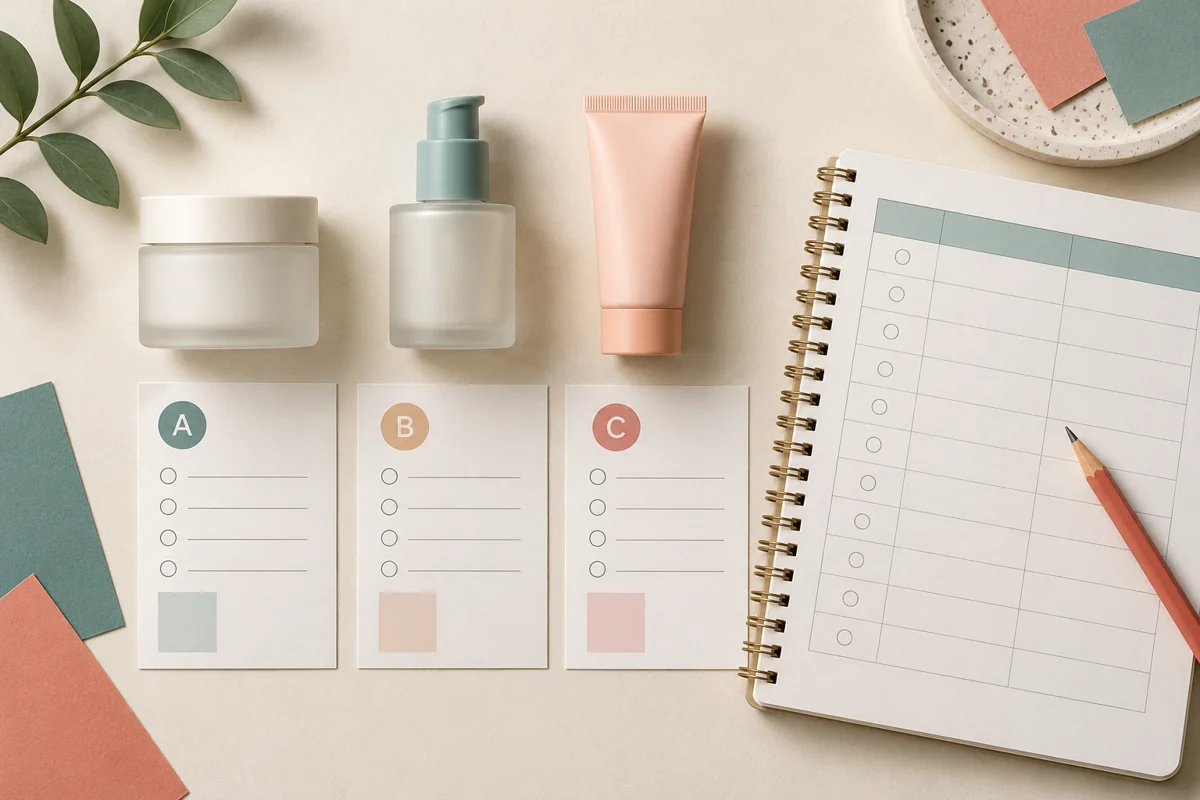
Useful cosmetic sample feedback tells a development team exactly which sample was reviewed, what was observed and what decision is needed next. “We like it, but make it lighter” leaves too much room for interpretation. It may describe colour, fragrance, spreading feel or the sensation after application.
For brand owners, the aim is not to become the formulator. It is to translate the product brief into a clear review record, while leaving technical feasibility and safety decisions with the qualified people responsible for them. A controlled feedback process also prevents an old sample, an informal message or a partially agreed change from becoming the production reference by accident.
This checklist is general project-management guidance for skincare, haircare and other cosmetic development discussions. It is not a testing protocol, a safety assessment or a promise about any supplier’s services. Only review a development sample in the way authorised by its supplier and the responsible technical team.
1. Identify the sample before discussing the product
Put the project name, SKU and supplier’s sample identifier at the top of every feedback record. Add the formula or revision code exactly as supplied, the date received and the date of the review. If the label is unclear or the sample has no reliable identifier, ask for clarification before reviewing or approving it. Do not invent a formula code that could be mistaken for the supplier’s record.
Record the container too. A laboratory jar and a proposed retail pump can present the same formula differently. State whether the sample arrived in a temporary container, a prototype pack or the intended production pack. Keep the packaging reference separate from the formula reference so that a change to one is not assumed to change the other.
Photograph the label and container where appropriate, without exposing confidential formulation information to unnecessary recipients. Link those photographs to the feedback record. A picture of a white cream without its identifier is rarely enough to establish which revision a colleague means.
Use one record per product and revision. A combined note saying “the cleanser and conditioner are approved” is difficult to interpret if only one of them was subsequently changed.
2. Agree what this review is meant to decide
Before distributing samples, define the review question. An early round might assess the overall sensory direction. A later round might address one requested change. Neither automatically decides packaging suitability, marketing claims or readiness for commercial production.
Write down the relevant part of the brief and identify what must remain unchanged. For example, the team may want a less noticeable fragrance while retaining the current appearance and dispensing experience. If these are preferences rather than fixed requirements, say so.
Separate three kinds of comment:
- Observation: what the reviewer actually noticed under the authorised review conditions.
- Preference: how that experience compares with the agreed brand direction.
- Technical question: what the development or quality team needs to investigate or confirm.
This distinction keeps a personal preference from being presented as a measured defect. It also prevents a technical concern from being dismissed simply because most reviewers liked the sample.
3. Keep the review conditions understandable
Ask the supplier what the sample is intended for, who may review it, what instructions apply and whether any restrictions remain. A sample sent for appearance review should not become an informal human-use trial. Where use evaluation is authorised, follow the supplied instructions and the responsible team’s review plan; do not devise extra exposure, mixing or stress conditions yourself.
Record enough context to interpret the comments: reviewer, review date, sample condition on arrival, storage instructions followed, container used and any departure from the agreed process. If a sample arrived leaking or without clear directions, flag that first rather than treating the subsequent experience as a normal comparison.
For comparisons, use the same agreed reference and describe relevant differences in conditions. A remembered product experience from months ago is not equivalent to a documented comparison. If a benchmark product is used, identify its exact version and explain which characteristic it illustrates. It is a discussion reference, not permission to copy its formula or claims.
Do not add water, fragrance or other materials to see whether a sample could be improved. The FDA’s microbiological-safety guidance explains that contamination can arise from ingredients, packaging, storage and consumer handling, and advises against adding water or saliva to cosmetics. Follow the sample’s handling instructions and keep any technical modification with the responsible team.
4. Describe the experience instead of prescribing the formula
A brand’s most useful contribution is a precise account of the intended experience. It is usually more helpful to describe a problem than to request a particular ingredient percentage without technical justification. A seemingly simple change may have consequences the reviewer cannot evaluate from appearance or feel.
Use the following comparison as a writing aid, not as a set of required tests.
| Unclear feedback | More useful feedback |
|---|---|
| Make it lighter. | The colour matches the brief. The concern is the lingering surface feel during the authorised review, not the colour. Please discuss options for a less noticeable after-feel. |
| The smell is wrong. | The fragrance direction is acceptable, but its perceived intensity is stronger than the agreed reference. Please review that difference without changing the direction. |
| The pump does not work. | Sample S-03 in pack P-02 did not dispense during the instructed use sequence. The supplied container and a short demonstration are attached for investigation. |
| Approved, except the texture. | Revision requested. Appearance and fragrance direction are accepted for this review; texture remains unresolved. This is not final sample approval. |
Describe only what happened. If the cause is unknown, leave it unknown. “There was visible separation on receipt” is an observation; “the preservative failed” is a diagnosis that the brand reviewer may not be able to support.
Use photographs or short videos when they clarify an observable issue. Keep the sample identifier visible or include it in the file name. Note that camera lighting and display settings can alter perceived colour, so an image alone should not become an exact colour specification.
5. Keep sensory feedback separate from safety and evidence
A pleasant fragrance, attractive appearance or positive application experience does not establish product safety, shelf life or claim support. Equally, a short internal review cannot replace a professionally planned assessment merely because no problem was noticed.
The FDA’s guidance on cosmetic product testing describes safety evaluation using relevant existing information and, where needed, additional scientifically sound testing. This is a U.S. reference illustrating the distinction between informal experience and technical evidence, not a statement of the requirements for India or another destination market.
Maintain a separate technical-question list. Ask the responsible reviewers which safety, stability, microbiological, packaging or claims assessments apply, which version they cover and what remains outstanding. Do not copy a report status from an earlier revision without confirming its relevance to the current one.
If a reviewer experiences a reaction or a sample shows a suspected quality problem, stop that review and notify the responsible supplier or technical contact. Do not encourage further use to confirm the result. Record the facts and follow the appropriate professional advice and reporting process. Keep personal health information out of general feedback circulation unless it is necessary and shared appropriately.
6. Consolidate comments without hiding disagreement
Nominate one brand-side coordinator to collect the feedback. Preserve individual observations, then send a consolidated decision record. This avoids a supplier receiving conflicting instructions from marketing, purchasing and founders in separate conversations.
Group comments into three priorities: matters that block the next decision, changes the brand would prefer, and characteristics to retain. If reviewers disagree, record the disagreement rather than averaging it into a vague request. Ask whether the difference reflects the brief, different conditions or different preferences.
A small internal group is not automatically representative of the intended customers. Describe it honestly as an internal review. Do not turn a handful of favourable comments into a consumer-performance statistic or a substantiated advertising claim.
Before sending the summary, check that each requested change has a clear owner and reason. “Please improve the formula” is not a decision. “Please advise whether the after-feel can move toward the stated brief while retaining the accepted fragrance direction” gives the technical team something specific to discuss.
7. Ask for the implications of each revision
Request a written response to the proposed changes before assuming the next sample will incorporate them. The response should distinguish accepted requests, alternatives, questions and requests that are not feasible within the current scope.
Ask whether the proposed revision changes the formula reference, packaging assumptions, assessment plan, cost or timing. Do not assume that a revision is free, that an earlier quotation still applies, or that the next round will fit inside the original timetable. Keep those commercial questions separate from the sensory decision.
Our cosmetic manufacturing quote comparison checklist explains how to keep inclusions and unresolved work visible. If the requested change involves the container or dispensing format, use the packaging compatibility guide to structure the questions for the responsible technical reviewers.
When a new sample arrives, do not overwrite the previous record. Link the new code to the requested changes and compare the supplier’s change summary with your feedback. Reopen any characteristic that has changed unexpectedly, even if it was accepted in the earlier round.
A reusable cosmetic sample feedback record
A shared document or simple spreadsheet can work if its version and decision owner are clear. Include these fields:
- Identity: project, SKU, supplier sample code, revision, container reference and dates.
- Purpose: the specific question this review is intended to answer.
- Basis: brief revision, authorised instructions and agreed reference.
- Observations: factual notes with reviewer and relevant conditions.
- Requested changes: each change, its reason and its priority.
- Retain: characteristics accepted for this round that should not change without discussion.
- Open technical matters: evidence needed, responsible person and decision affected.
- Supplier response: agreed revision scope, alternatives and implications still to confirm.
- Decision: hold, revision requested or acceptance for a precisely defined stage.
- Authorisation: named decision-maker, date and link to the retained record.
Avoid leaving a field blank when it matters to the decision. Use “not reviewed,” “not applicable” or “awaiting confirmation,” as appropriate. An empty field can later be mistaken for a completed check.
8. Make approval narrow, explicit and traceable
Approval should identify the exact sample and what has been accepted. “Sensory direction accepted for sample S-04, subject to the listed outstanding technical reviews” is different from authorising production. If conditions remain, name them and identify who will close them.
Do not use an informal “looks good” message as a substitute for the agreed sign-off process. The person authorised to choose a fragrance direction may not be authorised to approve a commercial order or accept technical evidence.
Keep the agreed reference and associated records according to the supplier’s handling and retention instructions. Record where the reference is held and who controls it. If a subsequent change is proposed, establish whether a new review or approval is required before replacing the reference.
Frequently asked questions
How many people should review a sample?
Use the people and review method appropriate to the agreed purpose. There is no universal internal panel size. A brand preference discussion, a professionally designed consumer study and a safety assessment are different activities and should not be described interchangeably.
Can we approve one characteristic while requesting another change?
Yes, but record partial acceptance clearly and keep the overall status as a revision request or conditional stage decision. Ask whether the proposed change could affect characteristics already accepted. Do not label the whole sample finally approved when a material change is outstanding.
Should feedback include exact ingredient changes?
Share genuine formulation requirements from the brief, but avoid guessing technical corrections. Describe the desired outcome and ask qualified reviewers to assess options, feasibility and consequences. A preference does not establish an appropriate ingredient or concentration.
Does sample approval mean the product is ready to sell?
No. A sample decision covers only its stated scope. Required technical review, documentation, packaging, claims, commercial arrangements and release decisions must be addressed by the responsible parties for the product and market.
Make the next discussion easier to act on
The strongest feedback record connects four things: the identified sample, the agreed brief, the observed difference and the decision requested. That structure reduces ambiguity without asking brand owners to make unsupported technical judgements.
For background on La Med India’s trading and supply business, visit About Us. For a product-supply enquiry, use the contact page with the product category, quantity and intended market. Confirm the available scope and terms for your specific enquiry.