
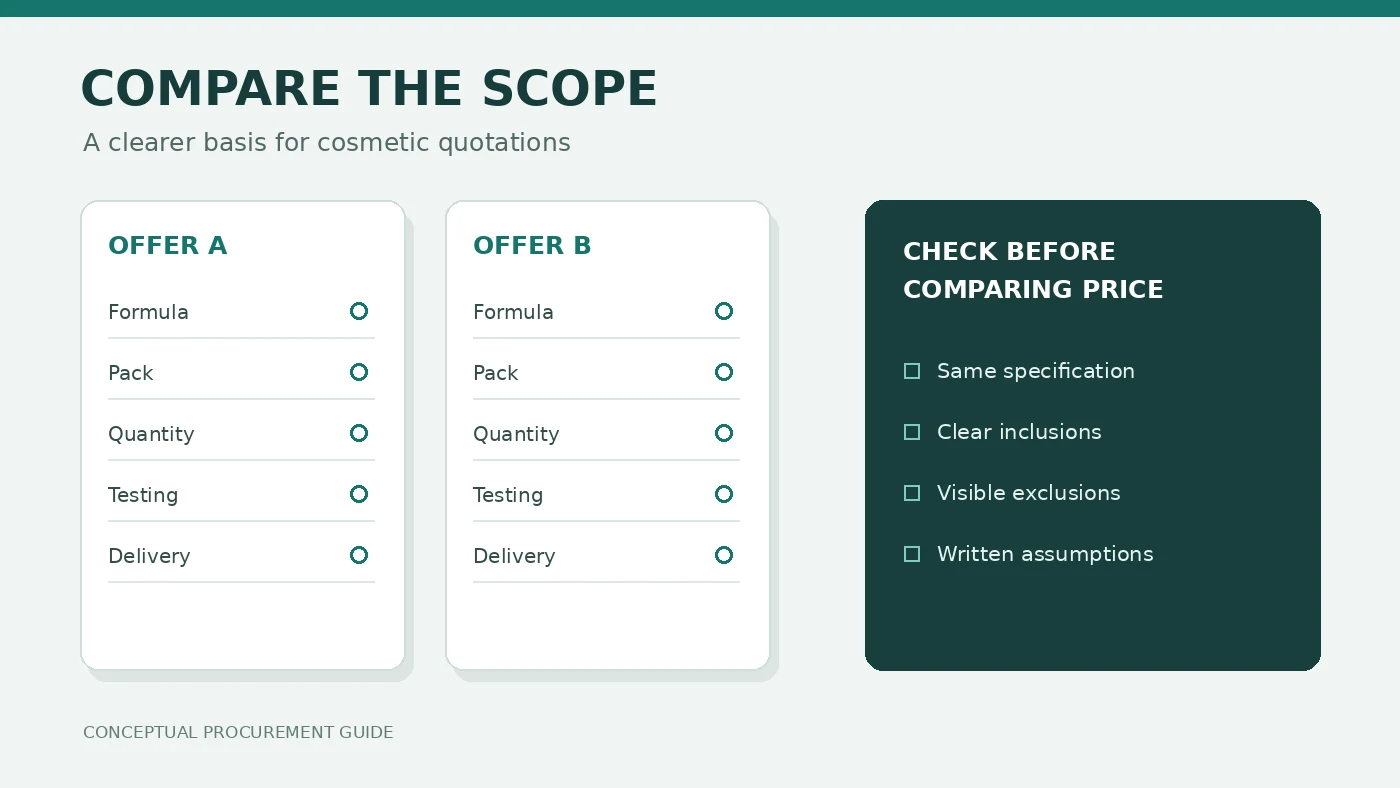
A cosmetic manufacturing quote comparison starts with the brief, not the lowest unit price. Two suppliers can describe an offer as a finished-product quotation while including very different work. One may price a filled and labelled pack; another may leave the carton, testing, artwork or delivery for the buyer to arrange.
For a skincare or haircare brand, the useful question is: what will this quotation actually deliver, at which stage, and what still needs a separate decision? A clear comparison makes gaps visible before a purchase decision, without assuming that a higher or lower price proves quality.
This guide provides a practical scope checklist for brand owners and sourcing teams. It is general procurement guidance, not a La Med price list, manufacturing offer, legal opinion or confirmation that any particular service is available. Product-specific requirements and commercial terms need written confirmation from the responsible parties.
1. Give every supplier the same version of the brief
Comparisons become unreliable when one supplier quotes a stock formula in a standard bottle and another prices custom development with a different pack. Start with a dated brief and assign it a revision number. If the brief changes, ask which quotation lines need updating rather than comparing the old and new scopes together.
Include the product category, intended use, target market, pack size, quantity per SKU, preferred packaging and the stage of development. State whether you have an approved formula, a reference sample or only a concept. These are different starting points and can require different work.
Separate firm requirements from preferences. For example, a particular dispensing format may be essential to the consumer experience while the outer carton finish remains flexible. Ask suppliers to identify deviations explicitly. A proposed alternative can be useful, but it should appear as an alternative rather than quietly replacing the original requirement.
Use the same response deadline for comparison purposes, while asking each supplier to state quotation validity. A buyer’s requested deadline is not the same as an accepted production or delivery commitment.
2. Define the unit being quoted
Write down what “per unit” means. Is the price for bulk product, filling into a buyer-supplied container, a filled primary pack, or a retail-ready item with label and carton? Confirm the nominal fill quantity and whether the quoted quantity counts individual packs, sets or cartons.
Keep each SKU on its own line. A total range quantity can hide a minimum requirement for each size, fragrance, shade or packaging variant. Ask whether the quoted volume applies to one production run, one shipment or a forecast across several orders. Do not treat a forecast as a binding order unless the parties have expressly agreed that arrangement.
Record the currency, tax treatment stated in the offer and the place to which the price applies. Where currency conversion is needed for internal comparison, use one documented date and source. Keep the supplier’s original currency amount alongside the converted planning figure so a later exchange-rate movement is not mistaken for a supplier price change.
3. Separate recurring costs from one-time work
A first order may contain work that is not repeated on every batch. Make separate rows for development, sample preparation, artwork, printing setup, tooling and any other project-specific charges. Ask what triggers each charge and whether a revision or repeat order changes it.
Do not assume that a sampling fee is refundable, that revisions are free, or that a tooling payment transfers ownership. If the offer describes an adjustment against a future order, record the exact condition and obtain confirmation before using that adjustment in a comparison.
For an existing formula, clarify what adaptation is included. Changing fragrance, colour, ingredients, pack or claims can change the work involved. The quotation should identify the version being priced and any assumptions that remain open. Avoid treating an initial estimate for an unfinalised concept as a fixed price for the finished product.
A useful comparison shows two views: the confirmed first-order amount and the recurring scope for an equivalent repeat order. Keep unknown costs visibly unresolved instead of entering zero. A blank testing or transport line often means “not yet confirmed,” not “included.”
4. List packaging component by component
A single “packaging included” line is difficult to audit. Identify the container, closure or pump, label or direct print, seal, carton, insert and shipping case where relevant. Record material, size, finish and decoration requirements at the level needed to distinguish the offers.
Ask who purchases each component and who holds any excess stock. Packaging may be ordered in a different quantity from the finished goods; request the supplier’s actual requirement rather than applying a general rule. Clarify responsibility for storage, unused components and changes to artwork between orders.
Also distinguish a visual mock-up from the actual production-intent pack. An attractive photograph does not establish that the formula and pack work together. Our guide to cosmetic packaging compatibility before sampling explains the questions to bring into the technical review. In the quotation comparison, record who owns that review, what work is included and which pack version it covers.
5. Ask what testing and documentation actually cover
Replace broad phrases such as “all testing included” with a defined list. Ask for the purpose of each assessment, the material or finished-product version covered, the proposed method, the responsible party, the report to be supplied and the acceptance criteria to be agreed. Some work may occur during development; other checks may relate to the production batch.
Testing scope depends on the product, intended use, claims, packaging and market. A quotation is not proof that every appropriate assessment has been completed. The U.S. FDA’s product-testing guidance explains that available information and additional testing may both contribute to cosmetic safety assessment. That source is U.S. context, not a statement of Indian or other destination-market requirements.
Similarly, distinguish an ingredient document, a batch document, a facility certificate and a finished-product assessment. They answer different questions. Request the exact documents relevant to your project and have qualified technical or regulatory reviewers assess their scope, issuer, applicability and current status. A certificate name on a quote does not establish that the supplied document covers the product or requirement.
Do not infer a shelf life, clinical result, regulatory approval or marketing claim from sample appearance or a general “quality checked” statement. Keep unresolved evidence requirements in the comparison as open conditions.
6. Compare the delivery basis and the timing assumptions
Ask where the supplier’s quoted responsibility ends: collection point, dispatch location, named destination or another agreed point. Identify which transport, insurance, handling and destination costs are included and which need separate confirmation. An ex-factory figure and a delivered figure should not sit in the same comparison column without explaining the difference.
For international transactions, record any agreed Incoterms® rule together with the named place and edition. Do not use a trade-term abbreviation as a substitute for understanding the allocation of costs and responsibilities. ICC Academy’s explanation of common Incoterms misunderstandings notes that the rules do not replace a sales contract or determine transfer of title. Payment and ownership terms still require their own review.
Break timing into milestones: development, sample review, approvals, component availability, production, release and transport. Ask when each quoted period begins and what must be ready first. A production estimate beginning after approvals should not be read as the time from the first enquiry to delivery.
Record whether the timing is indicative or contractually agreed. If your launch has a fixed date, show it as a constraint for discussion rather than implying the supplier has accepted it. A comparison is more useful when it exposes dependencies than when it presents one unsupported arrival date.
A practical cosmetic manufacturing quote comparison sheet
Use one column for the common requirement and one column per supplier. For each response, mark confirmed, excluded, alternative or awaiting clarification. Attach the quotation reference and date to every column.
- Brief: revision, product category, intended market and development stage.
- Quantity: SKU-level units, fill size, batch basis and any component commitments.
- Formula: version being priced, permitted changes and unresolved development work.
- Pack: every included component, decoration specification and buyer-supplied items.
- One-time work: sampling, artwork, tooling and conditions for further revisions.
- Testing: defined assessments, responsible parties, reports and open requirements.
- Documents: exact deliverables and whether they are available, planned or conditional.
- Delivery: named point, transport scope, applicable trade term and excluded costs.
- Commercial terms: validity, payment milestones, change process and written exclusions.
- Decision: open questions, evidence owner and the date the comparison was last checked.
Keep the original quotations alongside the sheet. A summary should make differences easier to see, not replace the documents that contain the terms. Ask a supplier to confirm your interpretation if you have translated an unclear line into a comparison entry.
Worked example: two offers that need clarification
Imagine two offers for the same facial cleanser concept. Offer A describes a filled bottle and label, with cartons and transport excluded. Offer B describes a retail-ready pack but does not specify whether the dispensing closure matches the brief. Neither offer has yet identified the final testing scope.
The immediate decision is not which price looks lower. First, confirm the same bottle and closure, add or separately record the carton requirement, align the delivery point and obtain the missing technical scope. Mark both offers incomplete until those questions are resolved. This is an illustrative procurement scenario, not a La Med quotation or a description of any real supplier.
If Offer B proposes a different closure, retain it as a separate option. Evaluate its effect on the product experience and technical review before comparing its price with the original specification. This preserves a potentially useful alternative without disguising a scope change.
Turn clarification into a decision record
Send one consolidated list of questions rather than a series of disconnected messages. Quote the line that needs clarification, state your interpretation and ask for the missing information. Assign an internal owner to each unresolved technical, commercial or logistics question.
Once the responses arrive, update the comparison date and keep the superseded version. Before selecting an offer, check that the final written quotation incorporates the agreed changes. For export transactions, the U.S. International Trade Administration’s document guide describes the pro forma invoice as a pre-shipment negotiating document containing goods, quantity, price and other specifications. Destination-specific documentation still needs checking with the relevant parties.
Record why the selected offer meets the brief, which conditions must be completed before the next stage and who can approve later changes. A purchasing choice should not silently approve a new formula, unreviewed claim, different pack or revised delivery commitment.
Frequently asked questions
Should I choose the lowest unit price?
Only compare unit prices after aligning the scope. Then consider the evidence, execution responsibilities and commercial conditions relevant to your project. Price alone cannot establish product quality or whether an offer meets your requirements.
Is a sample approval enough to finalise the quotation?
It may resolve some development decisions, but packaging, quantity, testing, documentation and delivery assumptions can still remain open. Ask for a revised quotation that names the approved version and clearly identifies the remaining conditions.
Can I compare quotations before the formula is final?
Yes, for planning, provided you label estimates as estimates and keep their assumptions visible. Avoid treating them as fixed commitments. Update the comparison when the specification changes or the supplier issues a revised offer.
What if a supplier cannot provide a requested document yet?
Record whether it is unavailable, planned for a later stage or outside the offer. Ask what evidence can be reviewed now and what decision must wait. Do not mark the requirement satisfied simply because a document has been promised.
Prepare the questions before requesting the next quote
A useful comparison ends with fewer assumptions. Keep the product brief controlled, make exclusions explicit and separate confirmed amounts from unresolved work. That gives the brand team a clearer basis for discussion without creating promises that the supplier has not made.
For background on La Med India’s trading and supply business, visit About Us. To discuss a product-supply enquiry, use our contact page and include the product category, quantity and intended market. Availability, scope and terms should be confirmed for the specific enquiry.