
Sample approval gives a cosmetic project a reference point. It does not mean every later substitution is covered by that decision. A different pump, a revised ingredient grade or a new filling arrangement can create questions that were not part of the original review. The practical task is to identify what changed, decide what needs checking and make the resulting instruction clear to everyone using it.
For a brand owner, cosmetic change control is a structured way to manage those decisions after approval. This guide offers a working approach for procurement, product development and operations teams. It is not a testing protocol, a legal checklist for every market or evidence of any supplier’s capabilities. Product-specific technical and regulatory decisions belong with appropriately qualified reviewers.
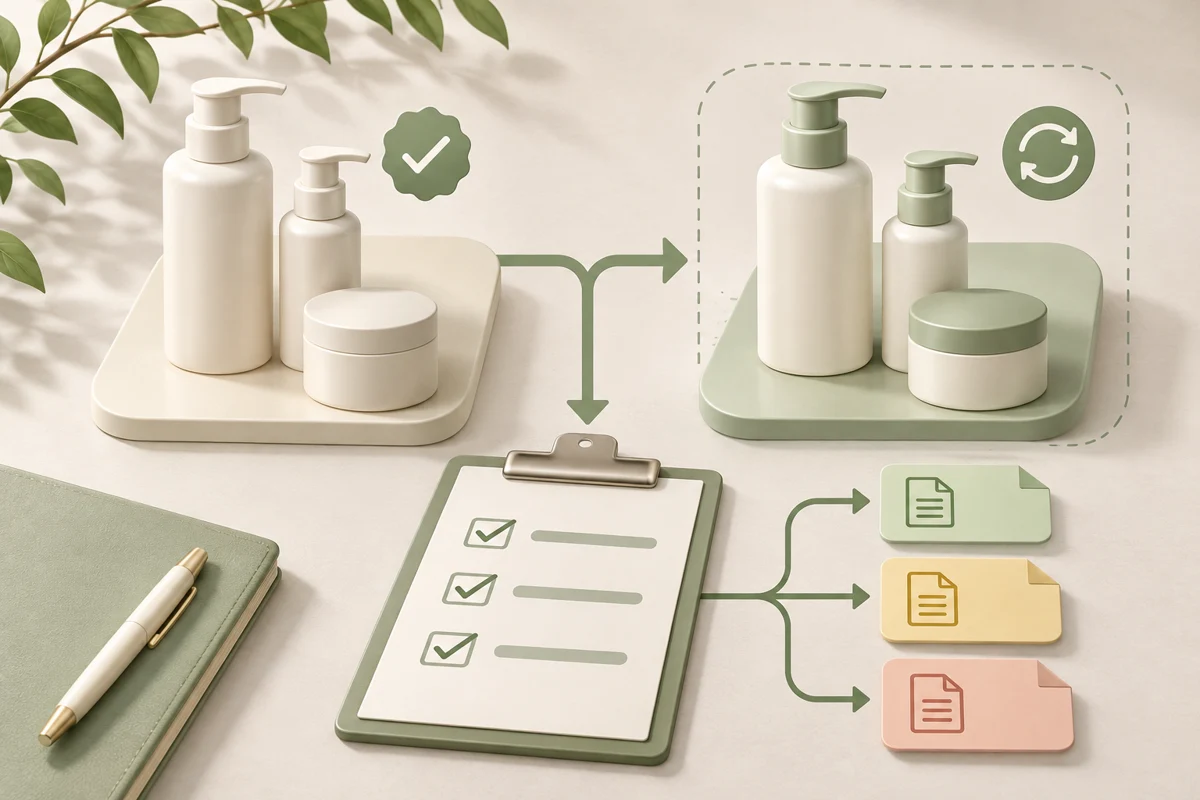
Start with the approved configuration, not a memory of the sample
Before evaluating a change, assemble the baseline that the team actually approved. Identify the product, formula reference and revision, sample reference, packaging component specifications and current artwork file. Where the brand does not hold confidential formulation details, agree on the controlled identifiers and change information that the manufacturer will provide. A photograph alone rarely establishes that two samples have the same specification.
Keep the approval date and scope beside those references. An approval of fragrance preference is different from approval of a complete product-and-pack combination. Similarly, a commercial acceptance email should not be treated as technical release. List any open conditions so the next reviewer does not assume that an unresolved item disappeared when the sample was signed off.
If the starting definition is incomplete, use a cosmetic product development brief to reconcile the intended product and its constraints. The aim at this stage is a reliable comparison point, not a longer document for its own sake.
Which changes should enter the review?
A useful intake rule is simple: record a proposed departure from the agreed configuration before the affected work proceeds. Do not make the commercial team decide alone whether it is technically important. The review can be proportionate, but the reason for treating a change as low impact should be recorded rather than assumed.
Formula or raw-material changes
Examples include a different ingredient grade, supplier, fragrance reference, colour or concentration. A familiar ingredient name does not establish that a new material is interchangeable. Ask the technical reviewer what information is needed to compare the old and proposed materials and whether the change affects the finished product specification, safety information or label. Do not decide the answer from a supplier’s informal statement that the material is equivalent.
Packaging and presentation changes
Record changes to the bottle, jar, closure, liner, pump, decoration or pack size. Distinguish a purely graphical proposal from one that changes the product-contact component or the way a consumer dispenses the product. Even if the outer appearance is nearly identical, the component specification may differ. Keep artwork review connected to this process without using an artwork sign-off as a substitute for reviewing the product-and-pack combination.
Manufacturing or operating changes
A proposed manufacturing location, equipment arrangement, batch scale, process sequence or subcontracted activity may need technical review. The brand does not need to prescribe the manufacturer’s process to ask whether an agreed product reference remains applicable. Record the proposed difference, who will evaluate its significance and what information can be shared to support the decision.
A seven-step cosmetic change control workflow
1. Open one request with a precise before-and-after comparison
Give the request an identifier and describe the business reason. Instead of “change the bottle”, record the current component reference, proposed component reference and affected product variants. Separate known facts from unanswered questions. Attach the actual revised drawing or specification rather than a message saying a document will follow.
Include the requested implementation point, but mark it as a request until reviewed. “Use from the next order” is ambiguous if packaging is already purchased or bulk product is in progress. Identify whether the proposal concerns a future development sample, a specific production order or all later orders of a defined product revision.
2. Identify what could be affected
Use a short impact discussion across technical, quality, regulatory, procurement and operations roles as relevant. Questions can cover the product specification, existing supporting evidence, label information, dispensing or use, supplier records, stock already held and customer-facing information. Assign each question to a named reviewer within the participating organisations. A long checklist without an accountable reviewer does not close an uncertainty.
Keep risk assessment separate from convenience. A shortage or launch date explains urgency, but does not demonstrate that the replacement is suitable. If a question cannot yet be answered, record the missing information and keep the affected decision open. Do not relabel uncertainty as “no impact” simply to move the order forward.
3. Agree the evidence needed before a decision
Ask the qualified reviewers which existing evidence remains relevant and what additional assessment or testing, if any, is needed. Define the question that each proposed check should answer, the version it will assess and who will interpret the result. Avoid ordering a generic list of tests without connecting it to the actual change.
For context, the US FDA’s cosmetic product-testing guidance explains that there is no single FDA list of tests for every cosmetic product or ingredient, and that additional testing may be needed to fill gaps in safety information. That is US guidance, not an Indian approval pathway. It reinforces the importance of a product-specific assessment rather than a blanket claim that one test report covers every revision.
4. Separate the technical decision from the commercial decision
The technical review should state whether the proposed configuration can proceed and under which conditions. The commercial discussion can then address revised quantities, cost, available materials and the production plan. Keep these decisions linked but distinct: accepting a revised quotation should not silently approve a formulation or component change.
Use clear outcomes such as approved, rejected or pending specified evidence. If approval is conditional, say exactly which activity is permitted and which remains on hold. For example, permission to obtain evaluation samples is not permission to use the component in saleable production. A status label should tell the reader what they may actually do next.
5. Update the controlled references and withdraw superseded instructions
Once the decision is complete, identify the new formula or component revision, applicable artwork and other affected records. Do not overwrite the previous version without retaining the history needed to understand earlier batches. Give purchasing and production the same current references, and make the status of obsolete working copies unmistakable.
For label and print files, connect the change record to the packaging artwork approval workflow. Record whether the artwork changed, was reviewed and retained, or is still pending. “No artwork change” is useful only when it is a deliberate conclusion rather than an omitted task.
6. Define the cutover and treatment of existing stock
The cutover is the point at which the approved revision starts to apply. Record the relevant order, component lot or first finished-product batch when those identifiers are available. Keep pending identifiers visible until confirmed. Explain how remaining old components and work in progress will be identified and handled under the agreed decision; do not assume they may be mixed, reworked or discarded.
Communicate the cutover to the people receiving and distributing the goods as well as those making them. If two approved versions will coexist, their records should allow the team to distinguish them. The batch traceability handover checklist explains how to connect product references with onward stock movements.
7. Check implementation and close the record
A signed decision is not evidence that the intended change was implemented correctly. Agree what the first affected batch or delivery review will check, then record the outcome and any follow-up. Confirm that the physical configuration and its accompanying records refer to the approved revision. If the result differs, route that discrepancy through the appropriate quality process rather than editing the original approval to fit it.
Ireland’s HPRA cosmetic GMP guide, section 4.14, describes documented, risk-based change control, evaluation and approval before implementation, with evaluation after major changes. It applies in its stated regulatory context; this article’s working template is not a claim of certification or compliance with that guidance.
A compact change record your team can adapt
Identity: request number, product and variants, requester, date and reason. Baseline: approved sample, formula, component and artwork references. Proposal: exact differences, proposed revision and intended implementation point. These fields should let someone outside the original email conversation understand the request.
Assessment: affected areas, reviewer for each question, evidence required and remaining uncertainties. Decision: approval status, conditions, decision-makers and date. Implementation: updated references, existing-stock decision, first affected order or batch and communication record. Closure: implementation check, result, unresolved follow-up and closure authorisation.
A small team can use a controlled spreadsheet with linked documents; a larger organisation may use a dedicated quality system. The important feature is that users can locate the current decision, see its evidence and distinguish it from an obsolete proposal. Restrict confidential information to the parties who need it, while ensuring each operational team receives the instructions necessary for its role.
Worked example: a pump becomes unavailable
Imagine a brand has approved a lotion in pump A, but purchasing proposes pump B before the first bulk order. This is an illustrative scenario, not a La Med case history. The request records the two component references, affected product and reason for the substitution. It does not say “same pump” based only on colour and neck size.
The reviewers identify what must be compared, what supporting information is available and which product-and-pack checks are appropriate. Procurement separately confirms the commercial effect. If the proposal is accepted, the record links the approved component revision, applicable artwork and implementation point. The first affected delivery check then confirms that the supplied configuration and records match that decision.
If the evidence is incomplete, the record stays pending. The team may discuss other options, but it should not treat a booked production slot or an urgent launch as approval. This is where the workflow earns its value: it makes the unresolved decision visible before it becomes an undocumented substitution.
Frequently asked questions
Does every change require a new sample?
Not automatically. The appropriate reviewer should decide whether the existing approval remains applicable, what evidence is needed and whether a revised sample is part of that evidence. Record the reasoning. Neither “always resample” nor “the original approval covers it” is a reliable universal rule.
Can a brand approve a change by email?
An email may form part of the approval record if it identifies the exact revision, decision, scope and authorised approver and is retained within the agreed process. A brief “looks fine” attached to an unclear file chain is much harder to use. Link the message to the controlled request rather than relying on individual inboxes.
How long should a change review take?
There is no useful universal duration. Timing depends on the proposed difference, evidence available, additional work required and reviewer availability. Ask for a plan tied to those dependencies and distinguish requested dates from confirmed commitments. Do not assume that a previous sampling or production estimate automatically covers new work.
What if a change has already happened?
Do not backdate an approval. Notify the appropriate quality and responsible business contacts, identify the affected material or batches and follow the applicable process for the discrepancy. The team needs to decide the next action using the actual facts. A retrospective record should clearly state what happened and when it was discovered.
Bring the proposed difference into the conversation early
When discussing a cosmetic project with La Med, prepare the approved reference, exact proposed change, affected variants and unresolved questions. Use the contact page to share the project context and ask which details are needed for review. Any feasibility, testing scope, commercial terms or implementation timing should be confirmed for that project rather than inferred from this general guide.